 Covalent
Covalent staking: First CXT Delegation Without a Node
Covalent staking lets CXT holders delegate to an active network operator and earn a share of its rewards without running a node. Delegation connects your stake to the operator's data work, with its commission reducing the rewards you can redeem. The dashboard uses Ethereum Mainnet and distinguishes token approval from a confirmed staking transaction. Operator activity and available delegation capacity matter before you commit CXT; withdrawing principal follows a different timetable from claiming rewards.
Active operators and recorded stake
An active operator can earn rewards for network work, while a disabled operator earns no yield for its delegators. A recorded position identifies the operator receiving your delegation and the amount committed. It doesn't establish a fixed future return. The dashboard separates active and disabled operators, so an existing stake needs attention when its operator stops participating, even though the position remains recorded.
Delegation through the data-work reward chain
Delegated CXT adds to an operator's stake, and earnings reflect stake weight alongside productive data work. The operator maintains the infrastructure supporting that work.
The operator's data work
Network operators maintain software and connectivity for their particular roles. The listed self-stake minimums are 175 000 CXT for a Block Specimen Producer and 35 000 CXT for a Block Results Producer. These are operator requirements, separate from the requirements for delegating. Block Specimen Producers and Query Node Operators can receive delegated CXT; the Block Results Producer role cannot. Running infrastructure also involves uptime and security responsibilities. Delegation gives a token holder participation through an operator accepting delegated stake, without requiring the holder to produce the data artifacts themselves.
Block Specimen Producers
Block Specimen Producers extract and normalize blockchain data into Block Specimens. These objects preserve data for a canonical representation of blockchain history. Producers submit specimen hashes to the ProofChain contract, which records proofs and compares inputs under its validation rules. ProofChain uses the submitted inputs to determine consensus on network rewards.
Block Results Producers and Query Node Operators
Block Results Producers trace, decode and enrich Block Specimens into structured Block Results. Query Node Operators host indexed blockchain data for queries, including access through GoldRush.
Your share of earned rewards
A delegator receives a proportional share of the selected operator's rewards, after commission. The relevant comparison is the delegator's contribution to that operator's total stake. The operator's own stake and other delegations affect that relationship. Additional delegations to the same operator can change your relative share. The staking contract records participation in this reward system; merely holding CXT in a wallet doesn't create an operator-linked position.
When is a first CXT delegation ready to submit?
A first delegation is ready when the Ethereum wallet holds the required assets and the selected active operator has room for the chosen amount. Connecting the wallet makes its staking activity accessible through the dashboard. You can stop before authorizing a transaction and leave the stake unchanged. A wallet connection, token approval and delegated position represent different states.
- The wallet is on Ethereum Mainnet and holds the CXT amount selected for delegation.
- The wallet also holds ETH for the transaction fees.
- The operator is active and has enough available delegation capacity.
- The approval request identifies the expected staking contract and the token allowance you're authorizing.
- The operator's commission and the principal's withdrawal cooldown are understood before committing the amount.
With those conditions met, select the operator and choose the amount to stake. The dashboard flow requires contract approval before the staking transaction. Approval gives the contract permission to spend CXT within an allowance. A successfully confirmed staking transaction establishes the position, which should then appear in the dashboard. Match that position to the selected operator and amount. If you stop after approval, the allowance remains even though approval alone hasn't created a delegation.
Commission, gas and the APY display
Operator commission reduces earned staking rewards, while Ethereum transaction fees pay for contract execution. The commission percentage applies to rewards on delegated tokens, not to the initial CXT amount as a deposit charge. Its rate can vary between operators. ETH pays for Ethereum gas, including approval and staking transactions. Commission and gas therefore affect different balances at different times. A position can accumulate CXT rewards while its separate ETH transaction costs reduce the value of participating. The displayed annual percentage yield, or APY, can change with emissions, total stake and operator performance. A past rate doesn't fix future earnings.
Reward emissions come from the staking reward pool. Their allocation and the amount of CXT participating determine the effective yield per token. Under an unchanged emission allocation, more competing stake reduces that yield. Operator performance adds another variable because rewards depend on productive work. Comparing operators therefore involves commission and activity together; a lower fee doesn't compensate for an operator earning no rewards.
Earned rewards and delegated principal
Earned rewards can be redeemed without the withdrawal cooldown applied to delegated principal. The contract treats claiming earnings and removing stake as different operations.
Reward redemption
The redeemable reward balance reflects earnings after the operator's commission. Claiming that balance requires a transaction fee, so its CXT amount and the ETH execution cost remain separate. Redemption concerns rewards already available to the position. It doesn't make the original delegated amount withdrawable. A holder can claim available rewards while leaving the principal committed to the operator.
Principal withdrawal
The CXT dashboard flow specifies a 14-day unstaking period for delegators, subject to changes by the contract owner. An unstaking request begins that cooldown after confirmation. The unstaked amount becomes transferable to the wallet when its lock expires. The position's actual unlock status governs availability. Operator self-stake has its own longer withdrawal conditions, so a delegator shouldn't apply an operator's unbonding period to their own position.
CXT identity on Ethereum Mainnet
The Ethereum staking flow uses CXT, the Covalent X Token, following the token migration completed in 2024. CQT is deprecated for staking within the Covalent Network. Earlier CQT instructions can describe a different network or contract version. Staking migrated from Moonbeam to Ethereum Mainnet, while operators publish ProofChain proofs on Moonbeam. Token identity and network selection belong together: a matching ticker on another network doesn't establish compatibility with the Ethereum staking contract.
Operator changes and delegation limits
An operator can remain active while having no room for another delegation. Its permitted cap depends on self-stake and the configured delegation multiplier; existing delegations consume that capacity. Those system parameters can change. A full operator isn't automatically a failed operator, and its commission doesn't create additional room. Delegated CXT remains in the staking contract, even when your wallet controls the position. Wallet control doesn't prevent a contract failure. Operator reward penalties and disablement can affect earnings independently of the withdrawal schedule.
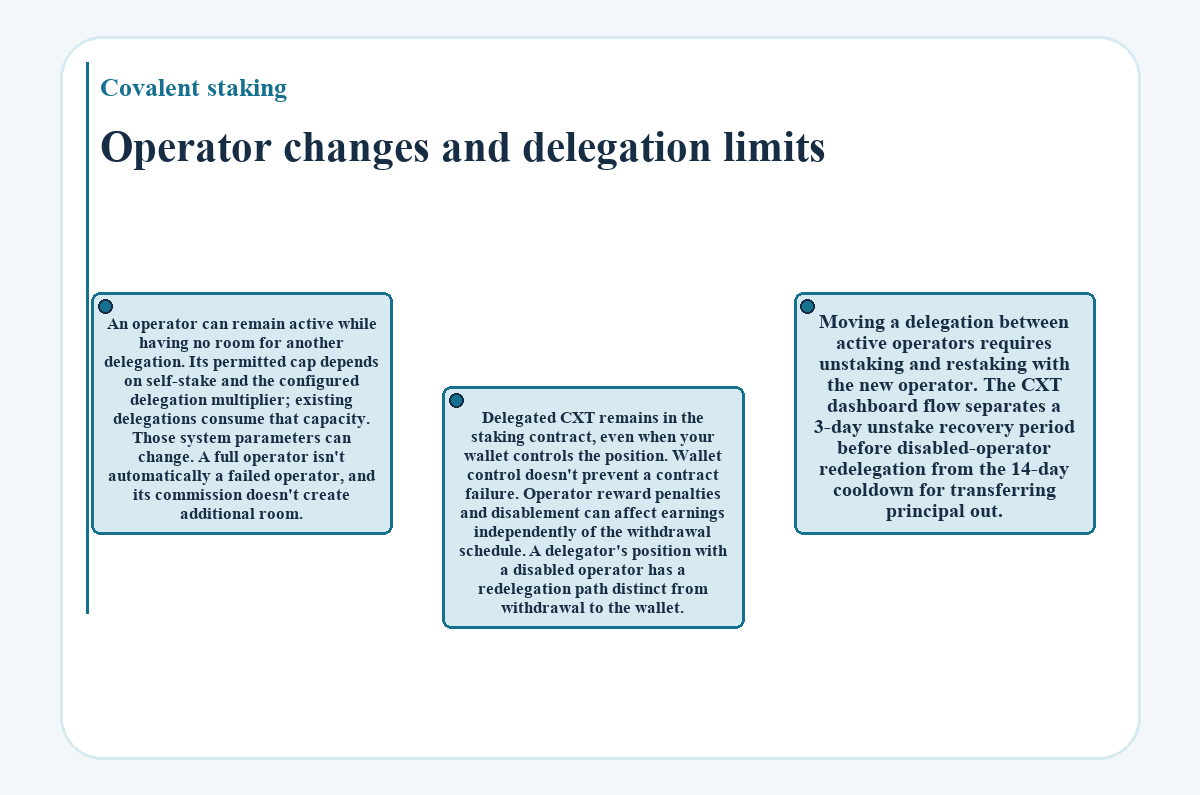
A delegator's position with a disabled operator has a redelegation path distinct from withdrawal to the wallet. Moving a delegation between active operators requires unstaking and restaking with the new operator. The CXT dashboard flow separates a 3-day unstake recovery period before disabled-operator redelegation from the 14-day cooldown for transferring principal out.
Practical questions
Is there a minimum CXT amount for a delegator?
CXT delegation has no minimum token requirement. The self-stake thresholds for node operators don't apply to a holder delegating through an operator. Available capacity can still limit the amount an operator accepts, and Ethereum transaction fees remain payable even for a small delegation.
Can CXT staking rewards be sent to a different wallet?
Redeemed CXT rewards can go to a beneficiary address different from the wallet managing the stake. Choosing that recipient doesn't transfer ownership of the delegated position. The beneficiary address needs to match the intended recipient.
Will a failed staking transaction still cost ETH?
A staking transaction can still consume ETH for gas when execution reverts. Ethereum charges for computation performed even when execution fails. The reverted transaction doesn't establish the intended delegation. This differs from declining a wallet request before submission, which hasn't sent a transaction to execute.
Which token contract identifies Ethereum CXT for delegation?
Ethereum CXT uses token contract 0x7ABc8A5768E6bE61A6c693a6e4EAcb5B60602C4D. This identifies the token involved in staking, while the staking contract manages delegated positions. A familiar token name in a wallet isn't sufficient to distinguish CXT from another token with a similar label.
Why can rewards remain unchanged just after a confirmed CXT delegation?
The staking dashboard updates rewards at the end of each epoch. A newly confirmed stake can therefore appear before the displayed reward balance changes. A delay in the earnings display alone doesn't establish that delegation failed.
What happens to a CXT allowance when I disconnect the staking wallet?
Disconnecting a wallet doesn't revoke an ERC-20 token allowance already confirmed onchain. The allowance remains permission for its approved spender until it is changed or consumed under the token's rules.
How can an existing CXT delegation be increased?
The staking dashboard's Top Up action supports adding CXT from the wallet or staking rewards available to the position. An increase remains subject to the operator's delegation capacity.
Must CXT be delegated before its holder can vote on staking proposals?
Holding CXT grants governance voting eligibility without an additional delegation requirement. Formal voting takes place on Snapshot after governance discussion, with voting power proportional to holdings. Proposals can concern staking parameters.